Sciogen : Codebase Intelligence Layer for Coding Agents
sciogen builds a queryable knowledge graph over your codebase. Index once with tree-sitter, and questions like who calls this? or what breaks if I change it? become sub-second lookups returning typed file:line objects — not raw source. Built for coding agents over MCP. It never calls an LLM itself.

Building sciogen — a codebase intelligence layer for coding agents
TL;DR — sciogen indexes a codebase once into an embedded triple store, then answers questions like "who calls
AuthService.login?" or "what breaks if I change this?" as sub-second lookups that return typed objects withfile:linelocations — not grep output, not raw source dumps. It never calls an LLM. It's to your codebase what Elasticsearch is to documents.
The problem: files are the wrong granularity
A coding agent understands a codebase the only way it can — by reading files. To learn the callers of one function, it opens dozens of files and pulls thousands of lines of source into its context window, most of it noise. Ask "what breaks if I change this signature?" and it does the same crawl again, from scratch, every single time.
That's backwards. The structure of a codebase — who calls what, what imports what, where a concept lives — doesn't change between questions. It should be computed once and then queried, the same way a database builds an index once and serves millions of lookups against it.
That's the whole idea behind sciogen.
What it feels like
You run one command inside your repo:
sciogen index .
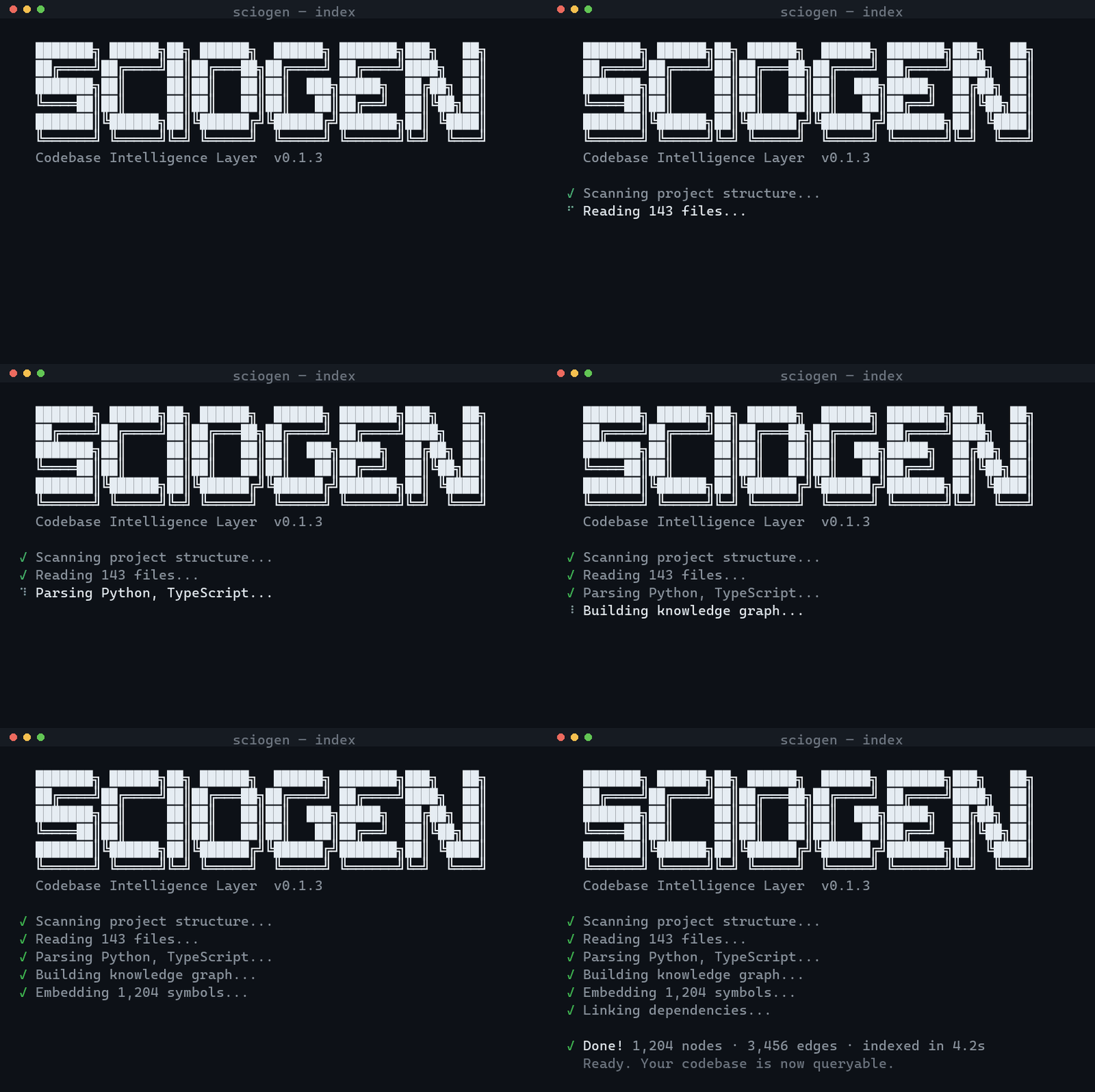
Five stages run per file, and the whole graph lands in a .sciogen/ directory
inside the repo. A single-file change re-indexes in under a second, because
a SHA256 differ skips everything whose hash hasn't moved.
From then on, the questions are instant.
"What breaks if I change this?"
This is the query that used to mean reading forty files. Now it's one call:
sciogen impact AuthService.login

The center node is the symbol you touched. Impact radiates outward hop by hop —
direct callers, then their callers — and the result is the union subgraph
of everything that could break, each node carrying its exact file:line.
Notice the edges aren't all the same: a call sciogen resolved with certainty is
a solid line; one it couldn't statically prove (dynamic dispatch, an injected
dependency) is dashed. Which brings me to the design decision I'm most happy
with.
Confidence, not silence
Static analysis is incomplete — that's a fact, not a bug. A call to login()
usually resolves cleanly to src/auth/service.py:AuthService.login. But some
calls go through dynamic dispatch, monkey-patching, or dependency injection,
and no static tool can prove where they land.
The tempting move is to drop those edges. That gives you a clean graph and a lying one. sciogen keeps them — with a low confidence score instead of full trust:
| Edge kind | Confidence |
|---|---|
IMPORTS, DEFINES, EXTENDS, direct CALLS | 1.0 |
CALLS resolved via imports | 0.8–1.0 |
CALLS via dynamic dispatch / injection | 0.2–0.5 |
Filtering happens at query time, never at write time. The graph stores
everything; the caller sets its own threshold. An agent that wants only
rock-solid edges asks for min_confidence=0.8; one exploring blast radius takes
them all and weighs them itself.
How it works, in one breath
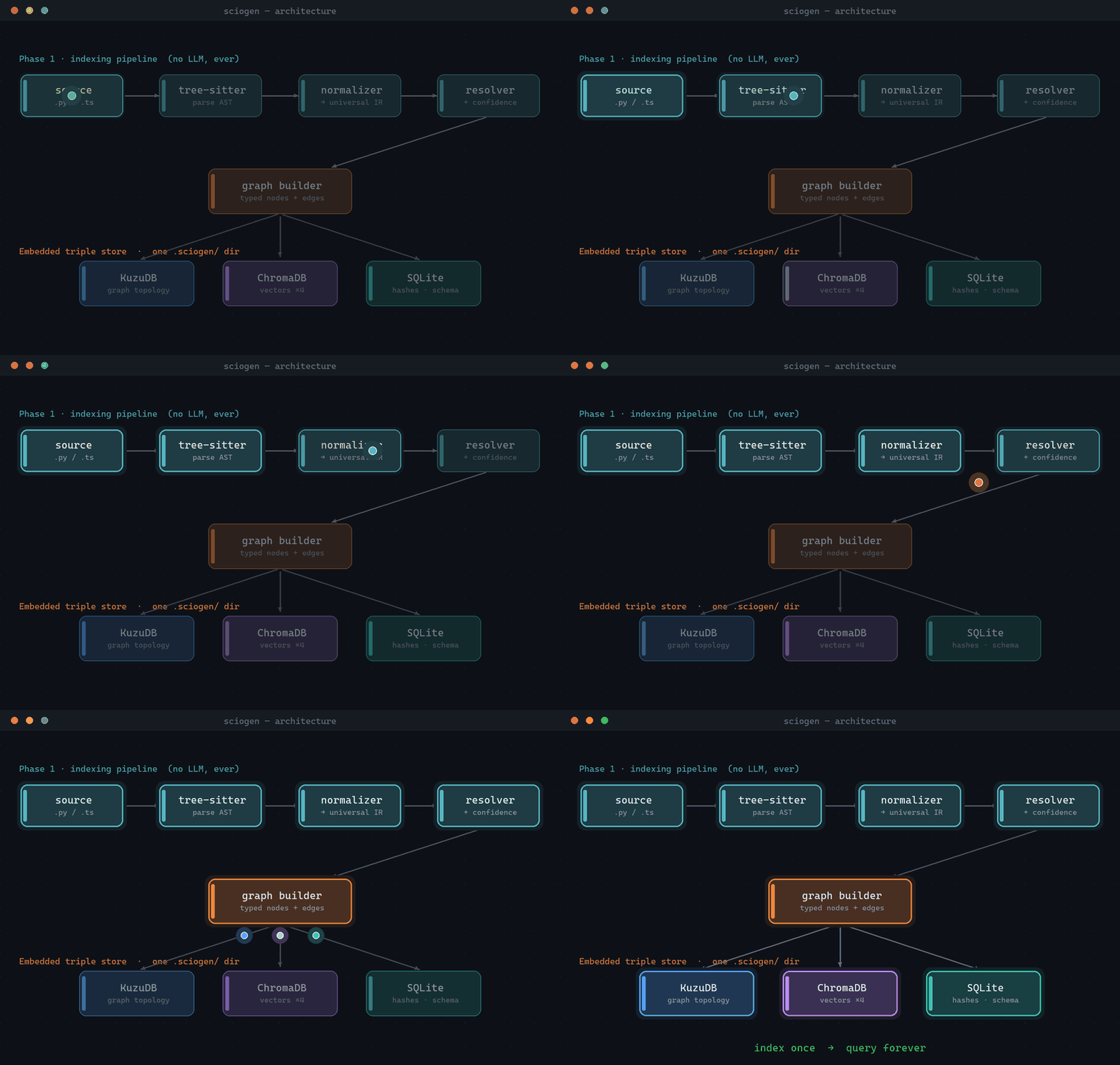
sciogen index is a five-stage pipeline, and the ordering is the point:
- tree-sitter parses the source — 100+ languages behind one API.
- A normalizer converts each language-specific AST into a single universal
IR. Python, JS, and Go all emit the same
ClassNode/FunctionNodeafter this step — so every layer downstream is language-agnostic. - The symbol resolver runs after parsing, on purpose. Tree-sitter gives you syntax; it does not give you semantics. The resolver traces each reference to the exact definition it points to and scores its confidence.
- The graph builder materializes typed nodes and edges into KuzuDB via Cypher.
- A SHA256 differ backed by SQLite makes every re-run incremental.
Embeddings of normalized symbol summaries — name, params, docstring, call list, never the raw code — go into ChromaDB at four granularities (file, class, function, chunk), so broad intent queries and precise retrieval each hit the right resolution.
Everything is embedded. No servers, no ports, no daemon — just one
.sciogen/ folder:
| Store | Role |
|---|---|
| KuzuDB | Graph topology — nodes, typed edges, confidence scores |
| ChromaDB | Vector embeddings at four granularities |
| SQLite | File hashes, symbol table, schema version |
Three modes of query, one deterministic engine
There's no ML routing inside sciogen deciding what you meant. The method you call is the mode:
# Structural — pure graph traversal on KuzuDB
graph.get_callers("AuthService.login")

# Semantic — cosine similarity on ChromaDB vectors
graph.search("password hashing logic")

# Hybrid — vector hits seed the search, the graph expands the neighborhood
graph.search("all code related to authentication", mode="hybrid")
Same from the terminal, for a quick human look:
sciogen search "password hashing"       # semantic
sciogen callers AuthService.login       # who calls this?
sciogen impact UserModel.find_by_email  # what breaks?
sciogen deps src/auth/service.py        # imports, transitive deps
The inversion that matters
Here's the part people get backwards: sciogen never calls an LLM. The LLM calls sciogen.
  the LLM  ⇄  agent host (Claude Code, Cursor…)  ⇄  sciogen  ⇄  .sciogen/ graph
  └ model ┘   └── owns the LLM connection ──────┘  └─ just a tool server ─┘
Your coding agent reaches the graph over MCP (the Model Context Protocol) —
register it once and the agent gets typed tools: get_callers,
analyze_impact, get_dependencies, search, get_diff_impact. One command
wires it up so the agent queries the graph before editing and refreshes the
index after:
sciogen setup-agent . --hooks
The token savings everyone talks about? sciogen is completely unaware of them. It has no concept of a token or a context window. The savings are a side effect of returning eight typed records instead of forty files. That happens entirely on the agent's side — which is exactly where it should.
And when you want to look yourself
Agents query the graph; humans want to see it. sciogen explore serializes
the whole graph into a single self-contained HTML file and opens it in your
browser — nodes colored by type, edges styled by confidence, sized by how many
things reference them. It starts collapsed at the file level and expands on
click, so a ten-thousand-symbol graph stays legible. No server, no port,
consistent with everything else in the stack.
sciogen explore
Try it
pip install sciogen
cd your-project
sciogen index .     # build the graph (incremental after)
sciogen explore     # look at it
sciogen mcp .       # serve it to your agent
Add .sciogen/ to your .gitignore — it's machine-local and regenerable.
sciogen is MIT-licensed and on PyPI. Source and docs live at github.com/ayanbag/sciogen or ayanbag.github.io/sciogen/. If you build something on top of it, I'd love to hear about it.
Related Links

github.com
github/sciogen
The source code and documentation for sciogen, the codebase intelligence layer for coding agents.
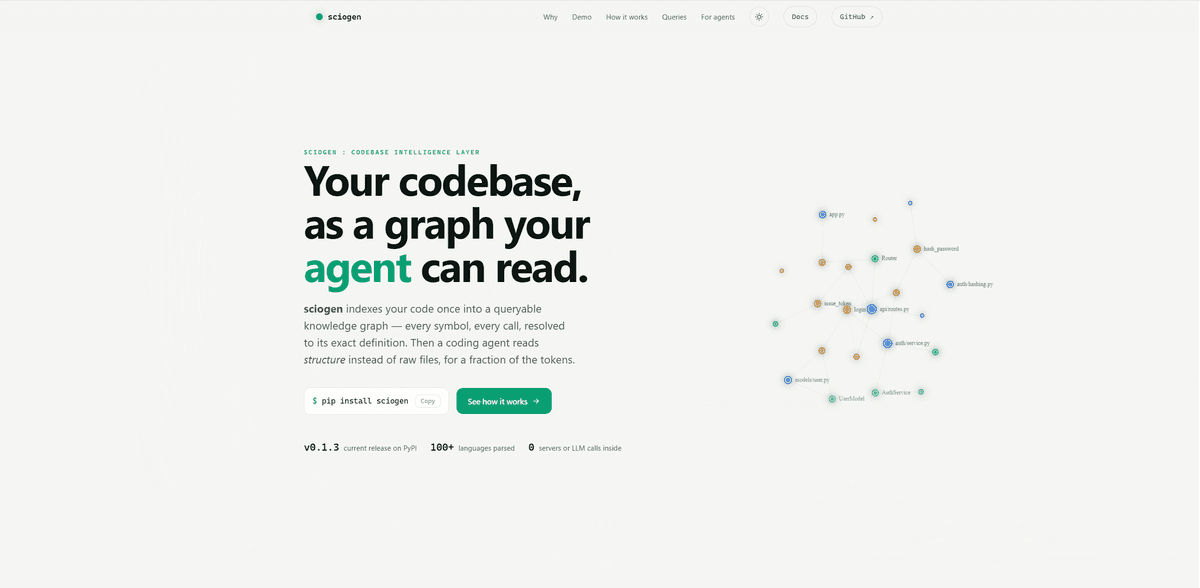
ayanbag.github.io
Sciogen docs
The official documentation for sciogen, the codebase intelligence layer for coding agents.